
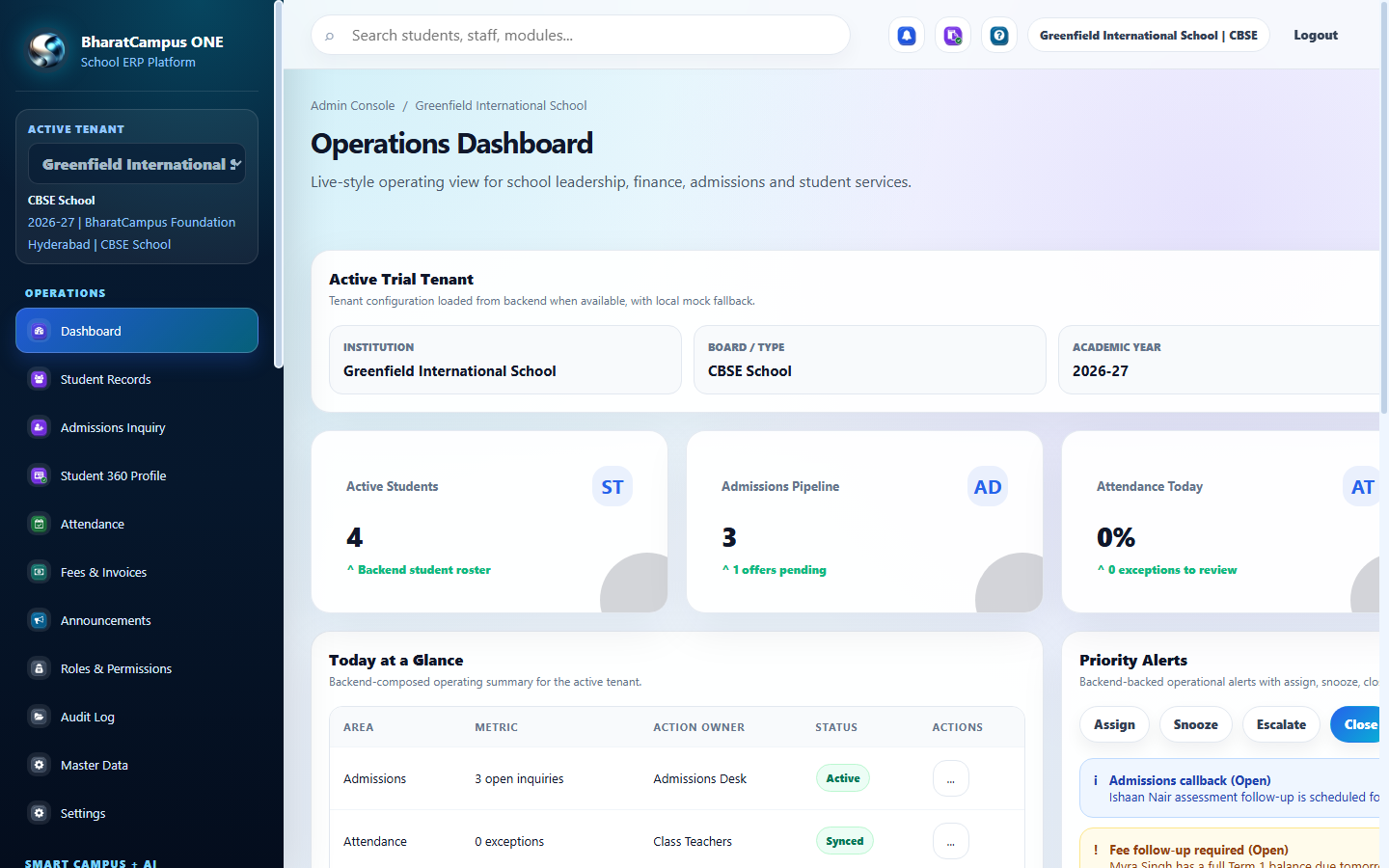
Begin with the school day you want to improve.
Before viewing a demo, identify three operational outcomes that matter. A private school may need faster fee follow-up, an inclusive school may need multimodal assignments and coordinated interventions, while a coaching institute may focus on inquiry conversion and course-specific communication. Clear outcomes keep the evaluation grounded in real work.
Operational clarity
Can leaders see what needs attention today without collecting updates from multiple teams?
Workflow completion
Does each process have an owner, evidence, approval where needed and a clear completion state?
Family trust
Can parents and students receive accurate, timely information without exposing unrelated records?
Staff adoption
Can a new user understand the next action without memorising the entire system?
Ask vendors to demonstrate complete workflows.
A screen is not a workflow. Request a realistic scenario from entry to exit and include corrections, approvals and negative cases. For admissions, that means inquiry capture, follow-up, application, document verification, assessment or waiver, offer decision, enrollment and student-record creation. For fees, include invoice creation, collection, adjustment, reversal and audit evidence.
Core workflows worth testing
- Admissions inquiry through enrolled student, including rollback and duplicate prevention.
- Student lifecycle changes with approvals, history and archive controls.
- Attendance capture, correction, locking, notification and reporting.
- Fee invoice, payment, adjustment, refund and reconciliation evidence.
- Announcements, circulars and targeted communication with consent controls.
- Assignments, study material and student submissions across supported media.
Verify data boundaries, permissions and evidence.
Multi-school software must enforce institute-specific data boundaries in the backend, not only hide navigation items in the browser. Ask how roles are created, how permissions are approved, whether users can hold multiple roles, how access is disabled and how role changes are recorded. Sensitive actions should retain actor, time, reason and relevant before-and-after evidence.
- Confirm isolation tests for APIs, exports, search, files, reports and background jobs.
- Review password, session, account-lock and administrator recovery controls.
- Check backup restoration, retention, deletion and incident-response responsibilities.
- Ensure public forms collect only necessary data and route notifications to accountable roles.
Measure implementation and support, not only software.
ERP value appears only after staff use the system consistently. Ask who owns data preparation, master-data configuration, role design, training, acceptance testing and go-live support. Reachable support means a documented path for raising an issue, understanding priority, tracking ownership and confirming resolution. It should not depend on knowing one individual informally.
Questions for the implementation team
- What must the school prepare before configuration begins?
- Which workflows are included in acceptance testing?
- How are administrators, teachers and finance users trained differently?
- What evidence confirms the school is ready to activate each module?
- What support channel and response expectations apply after go-live?
Compare total operating cost over three years.
A low subscription can become expensive when migration, integrations, training, support or manual work sit outside the proposal. Compare the same scope across vendors and document assumptions. Our School ERP Pricing & Total Cost Guide provides a worksheet for evaluating these costs without relying on a single headline number.
Use one evidence-based scorecard.
| Area | Weight | Evidence to request | Warning sign |
|---|---|---|---|
| Workflow completeness | 25% | Live end-to-end scenarios and negative cases | Only prepared dashboards or screenshots |
| Security and governance | 20% | RBAC, isolation, audit and recovery evidence | Security described only as user-interface restrictions |
| Usability and adoption | 15% | Role-based novice-user tasks | Every process requires vendor assistance |
| Implementation and support | 15% | Named stages, owners, gates and support path | Go-live date without readiness criteria |
| Total cost | 15% | Three-year scope and assumptions | Headline subscription with broad exclusions |
| Reporting and evidence | 10% | Traceable exports and operational reports | Reports depend on manual spreadsheets |
Choose a phased rollout with activation gates.
Start with stable identity, institute structure, master data and roles. Activate one or two high-value workflows, validate them with real users, then expand. A pauseable onboarding plan is healthier than switching on every module before ownership, training and support are ready.
- Days 1-30: discovery, data readiness, roles, master data and workflow acceptance criteria.
- Days 31-60: controlled pilot, corrections, approvals, reports and user training.
- Days 61-90: go-live, adoption monitoring, support review and next-module decision.