
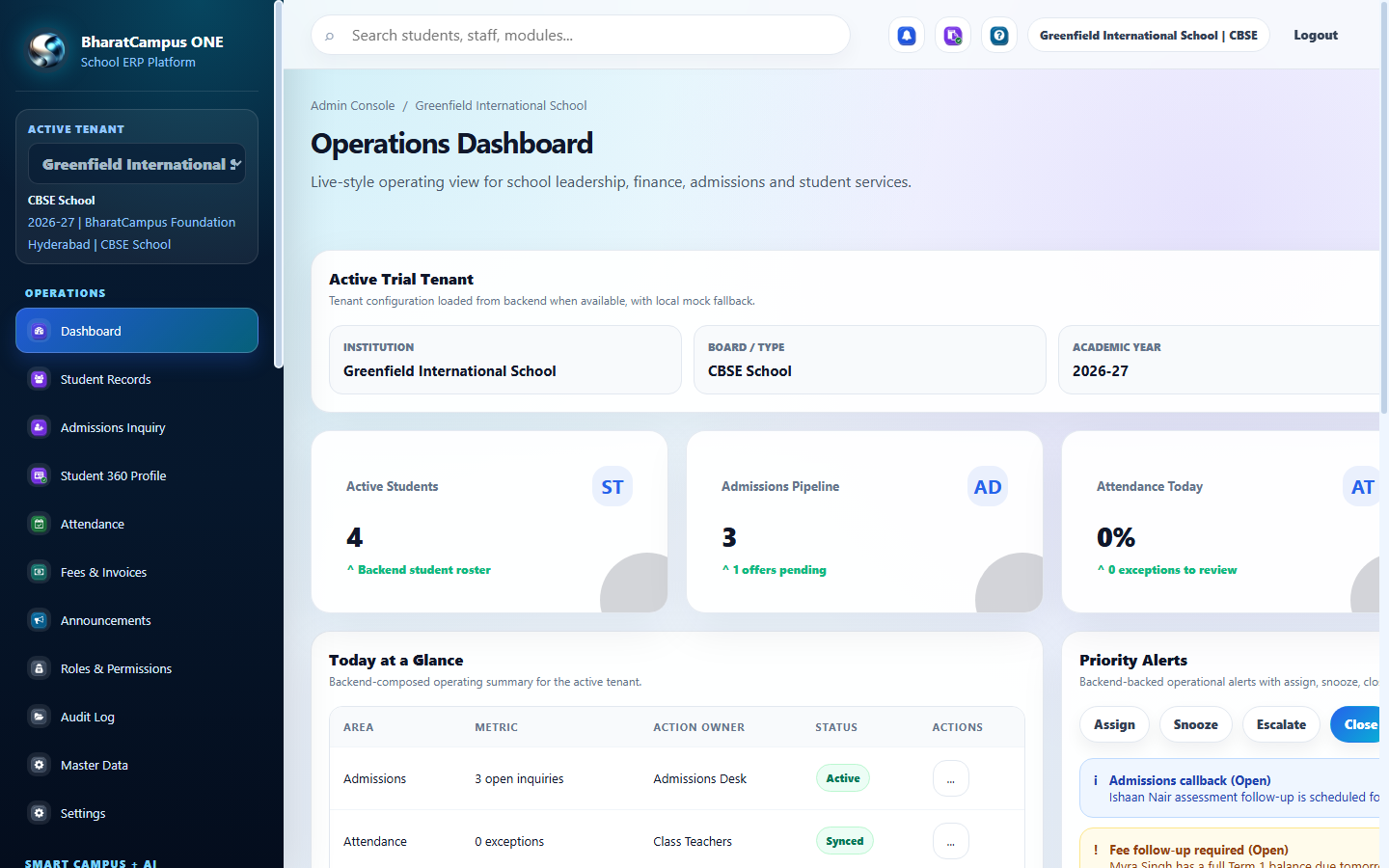
School ERP should reduce coordination work, not create another reporting burden.
A school already has people responsible for admissions, academics, attendance, finance, family communication and leadership reporting. The ERP should connect their work, retain evidence and surface exceptions without forcing every person to understand the entire system. Daily users need a short path to the next action; leaders need reliable status; administrators need controlled configuration.
One operating record
Move from inquiry to enrolled student without repeatedly entering the same identity and guardian details.
Exception-led work
Show missing documents, attendance corrections, payment exceptions and unanswered communication before routine records.
Clear ownership
Give each approval, follow-up and resolution a responsible role, due state and evidence trail.
Measured adoption
Introduce workflows in stages and verify that staff can complete them before activating the next module.
Core school operations should share context while preserving role boundaries.
- Admissions and enrollment: inquiry capture, follow-up, application, documents, assessment, offer, acceptance and student creation.
- Student records: identity, guardian relationships, enrolment history, documents, support cases and a unified 360-degree view.
- Attendance: daily or period capture, corrections, date locks, leave impact, parent alerts and escalation evidence.
- Fees: structures, invoices, payment posting, concessions, refunds, receipts, reconciliation, finance close and ledger evidence.
- Communication: approved templates, audience rules, consent, quiet hours, delivery callbacks and retry controls.
- Governance: institute-scoped roles, permission approvals, audit trails, retention controls and export evidence.
Configuration must reflect the school, board, academic year and operating model.
Indian schools vary by board, grade structure, language, fee schedule, campus model and the channels families use. A credible implementation begins by confirming academic-year boundaries, classes and sections, admission stages, fee heads, receipt controls, attendance rules, communication consent and role ownership. These are configuration decisions, not reasons to fragment the product into unrelated custom screens.
Questions to settle during discovery
- Which three workflows create the most delay or manual reconciliation today?
- Which records are authoritative, and what must be cleaned before migration?
- Which actions need principal, finance or administrator approval?
- Which channels do families rely on, and what consent or quiet-hour rules apply?
- What reports and evidence are needed for leadership, board or audit review?
The interface should prioritise daily work and progressively reveal specialist controls.
A role-based dashboard should answer three questions: what needs attention, who owns it and what can be completed now. High-frequency forms and queues remain visible. Configuration, history, exports and advanced controls can sit in clearly labelled expandable sections, available by pointer or keyboard without competing with the school day. Guided assistance should explain context and consequences rather than add another layer of clutter.
Trust depends on backend-enforced boundaries and reconstructable evidence.
Navigation hiding is not access control. Institute data boundaries, permissions, exports, files and background work must be enforced by the service layer. Sensitive actions should retain the actor, timestamp, reason and relevant before-and-after state. Schools should also agree backup, restoration, retention, incident and administrator-recovery responsibilities before production activation.
Use our security, RBAC and audit readiness guide for the evidence to request during evaluation.
Activate value in controlled stages.
Discover
Confirm outcomes, owners, source data, integrations, risks and acceptance evidence.
Configure
Prepare institute structure, master data, roles and the first high-value workflows.
Validate
Run positive and negative scenarios with real roles using synthetic or approved migration data.
Activate
Go live behind a readiness gate, monitor adoption and expand only after stable operation.
What a school-management team should see in the demonstration.
| Area | Scenario | Evidence of readiness |
|---|---|---|
| Leadership | Morning priorities and ownership | Exceptions are visible without opening every module |
| Admissions | Inquiry through accepted offer | Mandatory gates prevent premature enrollment |
| Attendance | Capture, correction and parent closeout | Locks, approvals and notification states are traceable |
| Finance | Invoice through reconciliation | Adjustments and close controls retain approval evidence |
| Security | Role change and restricted access | Backend denial and audit history match the role model |
| Adoption | New user completes one daily task | The next action is clear without specialist assistance |
For a vendor-neutral comparison, continue with the 2026 best school ERP buyer guide. For commercial planning, review BharatCampus ONE pricing and total-cost assumptions.